
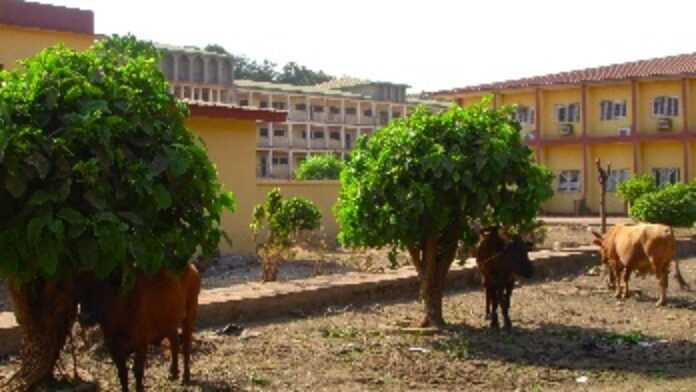
On Wednesday, May 28, 2008, a woman from Kankan, Guinea came to the University of Kankan to tell administrators about a dream she had. According to the dream, misfortune would befall the university the next day if a sacrifice were not made. Early the next morning, Thursday, administrators had two cattle sacrificed. A prayer service involving both the Bible and the Qur’an would follow.
At one o’clock that afternoon, a torrential rain began and continued to fall for hours, an auspicious sign that the sacrifice had been accepted according to University Rector Dr. Moriah Conté.
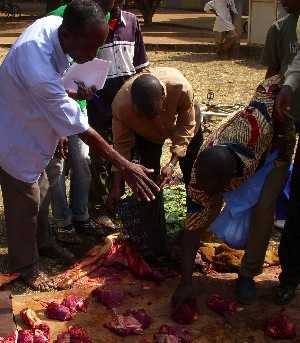
 The sacrifice occurred before I arrived on campus, so I missed it. But I had been present for the feast of Tabaski in December—the Muslim feast that commemorates Abraham’s near sacrifice of his son, Ishmael. The university had purchased several herd of cattle for the occasion, slaughtered them on campus, and distributed the meat among faculty and staff, sparking at least one debate over who might have taken too much. Administrators took the largest portions, and professors and teaching assistants the rest. I received a share, too.
Guinea’s population is roughly 85% Muslim, but Guinea is a secular republic. So I was amazed to watch a state institution transform itself into—or reveal itself as—a ritual site, just as it did that Thursday, May 29, in a sacrifice that came not a moment too soon.
 What began as a good day for the university started as a tense one for me. Two young men walked in front of me on the road while I was riding my bicycle to campus. I veered to avoid them but grazed one of their hands without drawing blood. They accused me of trying to run them over, then “forgave” me for my supposed carelessness. I bicycled on, confused, but on time for my 9:00 seminar. By 9:30, only one of my students had arrived. Another came by 9:45. Two of the others, I learned later, had been kept in an office by their chair to calculate end-of-term grades for their department.
That day’s class was an important one for me. I was going to give students feedback on their research proposals. After forty-five minutes, I stopped waiting. I went to find the missing students.
While walking through a crowd at the center of campus, I saw a young man approaching on a moped. He beeped his horn. The crowd had hemmed him in, but I was distracted and continued walking, like everyone else. As I passed him, I heard him mutter, Ah, le blanc!, “Oh, the white guy!”
I turned on my heels. I was already in a mood.
I walked up beside him—since the crowd wasn’t letting him move—and asked him why I alone needed to make room.
“You didn’t hear me beep?” he asked.
“I did, but does driving a moped mean you own the walkway?”
I bent down at the knees while facing him—a sign of deference I had learned from hunters in Côte d’Ivoire—and said, “Next time, I’ll bow and throw my shirt on the ground.”
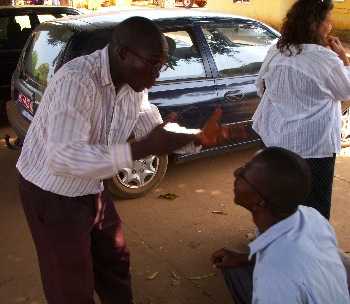
He stopped his engine and dismounted, took me by the hand, and bent toward the ground with me, asking me to stand. I refused. I was probably twice his age. My feigned deference—in violation of Guinea’s usual age hierarchy—must have made him feel as awkward as his “white guy” comment made me feel.
“I meant no trouble,” he said. “I hope there’s no problem.”
He sounded concerned.
“None at all,” I said.
We were making a scene.
Another student noticed, approached us, took my other hand, and asked me to stand, trying to resolve things.
“I hope there’s no problem,” he said.
“None at all,” I repeated. “Just this driver’s attitude.”
I then rose, assured the two that all was well, and said goodbye. But they refused to let go of my hands.
“Is everything okay? There’s really no problem?” they asked, as if seeking assurance that I would avoid any reprisals against them. I had no such intentions.
“No, really, no problem at all,” I said. We shook hands and said goodbye. I was fit to be tied.
I continued on to the department where two of my students were grading papers.
When I found the department chair in an open-air hallway, we greeted each other politely as students bustled past. I cut to the chase—never a good tactic in West Africa. I reminded him that my course was in session and that I had informed him in writing at the start of the semester of the course’s days and times.
“I never keep my students from your course because of office work,” he said.
“But today they are not in class,” I said.
“We have to report final grades for our classes by the end of the day,” he said. “I have no choice.”
“I understand,” I said, suddenly conceding everything. “I would have just liked to have been informed instead of postponing class to wait for them.”
I thanked the chair for his time. He flashed an obsequious smile, and we parted. I recalled that earlier in the year he had retained several of my students for a department meeting. Fate was pushing my buttons.
I was feeling as I often did in Kankan, like a cardboard cutout, a two-dimensional figure whose interior life, feelings, and expectations had no bearing because they diverged so much from everyone else’s. I was stuck in an acute case of culture shock.
By the time I got back to class, I was itching for a fight—metaphorically speaking. Near the end of the day, I saw the department chair from a distance and waved to him. He looked at me with what I interpreted as dismissal then looked away without returning my gesture. It occurred to me, not for the first time, that the woman who had dreamt of impending danger had me in mind.
The next day, Friday, I arrived early for class and sat in the cool morning air on a bench in front of the building where I taught. The chair arrived with a colleague and sat beside me. We greeted each other and exchanged pleasantries. A few minutes later in class, I learned that the two students who had been absent the day before were missing—again.
After class, I went to the chair’s department to leave a corrected grant proposal with one of my absent students. I found several professors and teaching assistants in the chair’s office busily grading. I greeted the chair and discussed my comments with my student before leaving, determined to avoid a confrontation.
That afternoon, as I was leaving campus and talking with one of my students, we walked past the chair, and I greeted him, trying my best to behave.
“You see how busy we are these days,” he said, referring to the scene in his office.
“Yes,” I said. “It’s been a busy two days for us, too,” I explained. “I’ve been giving students feedback on their research proposals.”
I asked my student to show him his typed proposal on which I’d made comments. The chair took several moments to look at it. His interest astonished me.
I hadn’t shown half as much interest in his grading deadline.
 Through all this, I couldn’t help but think about Wednesday’s sacrifice. It seemed to say that if I channeled my frustration in productive ways, I could feed others with it rather than harm them, as with the shared meat that followed the sacrifice at Tabaski. Looking back, sacrifice seems a lot to me now like electricity. It works when it’s available. All one needs to do is plug into it—like a natural fact—whether one understands it or not, whether one “believes” in it or not.
 The sacrifice that Thursday, like the one on Tabaski, didn’t need to be performed for me in order to work on me. It reminded me that the best way to deal with problems was not by pretending they were either insignificant or all important, but by sharing in others’ frustrations, like the chair’s. To show him that his chagrin and mine—the animal victim we could figuratively kill—were the same, that we could share the fruits of our frustrations’ defeat like the ritual meal that follows immolation. Unless we did, we would be too worried over who was more inconvenienced to get along—like my colleagues arguing over who took the greater share at Tabaski. The chair, the moped driver, and the young men I’d nearly run into seemed to understand this far better than I.
 I am not Muslim. I am not African. But even at a secular university, I was part of a ritual community, having received my share of meat at Tabaski. In Kankan, ritual was not just a religious attempt to manage practical affairs; it was a practical affair itself, apart from any religious affiliation.
If the Kankan woman’s dream had anything to tell me, it was that, in Africa and elsewhere, it’s only after one makes all the adjustments to living in another language and culture that the real sacrificing, learning, and adjusting begin.
