

French anthropologist Claude Lévi-Strauss, one of the twentieth century’s most revered intellectuals, died October 29 at the age of 100. He is best known for his writing on myth, but he touched on almost everything else, too, including history, incest, kinship, marriage, masks, painting, ritual, science, and totemism. He was the world’s foremost exponent of structuralist analysis, first developed by the Swiss linguist, Fernand de Saussure. Lévi-Strauss’s lasting contribution was to apply the perspectives of structural linguistics to understanding human culture. He proposed that everyone thinks about the world in the same way; only the content differs.
His insight may seem trivial. But consider that folks used to think—and many regrettably still do—that people outside Europe, North America, Australia, and urban Latin America and Asia are ignorant heathens. In this light, Lévi-Strauss’s ideas were revolutionary.
To illustrate his ideas, I want to begin with an example of structuralist analysis by way of Fernand de Saussure’s Course in General Linguistics (1916).
Common sense dictates that we have the word “sheep” in English because the word reflects their existence in the world. I see some sheep grazing in a field, I say, “Look at the sheep.” And you look at them, instead of at some rocks or trees. We understand each other. We see the sheep. They are out there.
Then our companion gets tired of watching the sheep graze, roasts them, and invites us to share some “mutton.” You and I understand the word even if we are vegetarians, since our words correspond to things as they are in the world. Or so we assume.
Saussure wasn’t so sure.
Compare the English words “mutton” and “sheep,” he said, to the way French-speakers talk about such things. Instead of two words, they have one: ‘mouton’. ‘Mouton’ can mean either “live sheep in the meadow” or “sheep meat on a platter.” But French-speakers appear no more or less competent at distinguishing mutton from sheep than English-speakers are (although when it comes to cooking it, we might have to make an exception).
Saussure concluded that no language has a monopoly on the right way to categorize things. No language is more “natural” than another. You can categorize the world any number of ways and still get by in it.
But back to the sheep.
 In English, “mutton” means “roasted sheep” because “sheep” means “woolly critters.” In French, one word means both. Saussure concluded that meaning lies between words rather than within them or in relation to the things they name. A word gets its meaning from its opposition to other words, not from the object it names. Without the word “sheep,” “mutton” means nothin’—and vice versa.
French-speakers only say ‘mouton’. While this could mean that they raise hybrid creatures—woolly and living in the front, roasted and dead in the rump—this is not the case. Nor does it mean that French-speakers can’t tell the difference between the sheep you shear and the ones you sauté.
What it means is that we understand the world not because our words stand in a one-to-correspond with things in the world, but because our words contrast systematically with each other in ways that allow us to draw analogies between relationships in the world and relationships between words. There are as many viable ways of doing this as there are languages.
 Enter Lévi-Strauss. He proposed that human culture works according to a same process of distinction. In his book ‘Totemism’ (1962), he wrote that clans have their particular totemic animals—a crow, a fox, a snake—not because each clan shares an underlying similarity with its totem, but because the differences among the animals stand for differences among the clans. The choice of the animal by each clan is arbitrary but meaningful. Without such choices, there would be no social organization. Our ways of thinking structure society as much as society structures our ways of thinking. Meaning is relational. It lies between things, not within them.
West Africa has taught me these lessons particularly well. One thing that consistently impresses me here is the way people who practice different religions manage to get along with each other—presuming that politicians and power-hungry religious leaders leave them in peace.
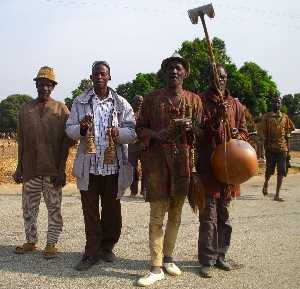
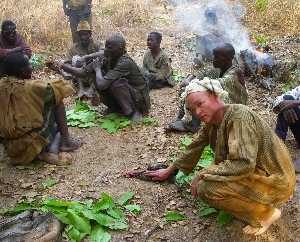
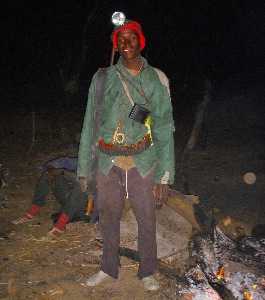
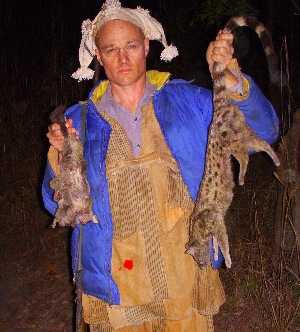
While I was doing research in Côte d’Ivoire from 1994 to 1997 among initiated hunters called ‘dozos’, my host, a dozo named Dramane Coulibaly, asked if I wanted to be initiated. I was flattered by the invitation and asked for some time to think about it.
 As a Roman Catholic, I thought I should give some thought about what it would mean in spiritual terms. Good friends who were Evangelical Protestant missionaries in the area suggested that it might bring me into contact with demonic forces. A Cameroonian priest in Côte d’Ivoire pointed me, in contrast, toward Lumen Gentium (1964), the Vatican II document that recognizes salvation outside of the Church. I also stumbled onto the writings of Jesuit theologian Raimon Panikkar, who wrote of the “Cosmic Christ”—from Paul’s image in Colossians (1:12-14)—as a salvific presence in all peoples, times, and places.
What harm, I wondered, could there be in participating in a ritual tradition as venerable as the dozos’? According to Malian anthropologist Youssouf Tata Cissé, dozo rituals predate the eighth-century empire of Ghana. And Sunjata Keita, who founded the empire of Mali in the thirteenth, was a dozo.
But it was the work of French priest and anthropologist, Jean-Paul Eschlimann, that most clarified my decision. While he was living in West Africa, several young Christian converts came to see him about a problem they were having. To access fields they wanted to farm, they needed to make a sacrifice to the local land priest. They thought Christianity would condemn the idea. They still needed to farm. What were they to do?
Eschlimann suggested they make the sacrifice out of respect for the land priest and keep their hearts focused on God.
Dramane told me something similar.
 He came to see me one day in the round, mud-brick, thatch-roofed house where I lived in his village of Nienesso in the northwestern-most Odienné prefecture of Côte d’Ivoire. He wanted to talk to me about my initiation. He told me that I would need to give him a red rooster and ten red kola nuts. He would then present these to Nienesso’s chief dozo who would sacrifice them on my behalf to the spirit of Manimory, the first dozo. We were speaking in the Mande language, Julakan. Our conversation went something like this:
“Youssouf,” he said to me in the sympathetic but slightly I-never-know-what-to-do-with-this-guy tone he often addressed with me. Then he paused and took several objects on the wooden table I used for a desk and arranged them like a sun with three planets orbiting it: a plastic cup encircled by a pen, an eraser, and a pencil.
He pointed to the cup in the center. “This is Allah,” he said. The pen was the Prophet Muhammad, the eraser Jesus, the pencil Manimory.
“We Muslims have Muhammad as our intermediary,” he said. “You Christians have Jesus.”
Coming to the pencil, he said, “We dozos have Manimory. Before we hunt, we make sacrifices to him because we are dozos. Our intermediaries take them to Allah.”
He was telling me that my sacrifice to Manimory would go to God just as surely as any sacrifice I made to Jesus would.
 “Youssouf,” he continued—I could feel a lesson coming—“Did your father pay for you to go to school?”
“Yes,” I said.
“Did he have to work for that money?”
“Yes,” I said.
“Wasn’t that a sacrifice?”
“Yes,” I said.
Dramane’s words were like crocodile jaws. Once trapped inside them, I could find no escape.
“Dozo initiation is a sacrifice, too,” he concluded.
I recalled how compelling he was when singing to dozos at dozo funerals to provoke them to kill game as a sacrifice to assure the dead’s safe journey to the afterlife
With a few choice words, he had performed a masterful structuralist analysis of religion. He argued that Islam, Christianity, and dozo rituals are what Lévi-Strauss would have called “structural transformations” of each other. They all do the same thing—relate to God through key intermediaries—in different ways.
Islam is Islam because it does what Christianity does, only through Muhammad’s reception of the Qur’an. Christianity is Christianity and dozoya dozoya because they give access to God in similar ways, through different persons.
Each religion has meaning in contrast to the others, not because they are all inherently different, but because they are structurally the same. Each manages to bridge the gap between God and humanity through a particular mediator: the Qur’an, the Christ, and the cardinal dozo.
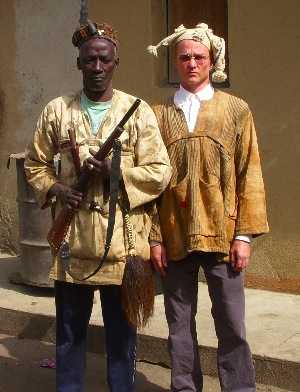 Dramane was uninterested in debates over which mediator was best. He noted only that they did the same thing for different people in different circumstances: confer sacrifices to God. Dramane could be a Muslim and still venerate Manimory. It was Manimory, not the Qur’an, who protected him in the forest. Both led to God. It was no coincidence that he called Manimory a Muslim saint or ‘waliju’, from the Arabic, ‘walid’.
Dramane was no anthropologist, but part of Lévi-Strauss’s genius was to recognize that non-scientists can understand the way the world works as well as scientists do, only differently. Many West Africans who are not academics grasp the spirit of structuralism nonetheless. They understand it through the systematic trial and error of everyday life—what Lévi-Strauss called ‘bricolage’ in French and what we might call “tinkering” in English.
Lévi-Strauss confirmed that seeing the world as a series of relations among human perceptions is smarter than assuming that human perceptions are identical with the world. From this perspective, differences among people, religions, and other human habits are less inherent, intransigent, and contradictory than they are analogous, flexible, and complementary. Like Dramane, Lévi-Strauss argued that it is our differences that make us the same.
In a world more eager to fight over its differences than resolve them, this is a message that none of us can afford to forget.
Lévi-Strauss worked for nearly a century to make sure we remember it.
