
Then came the exorcisms. Pastor Michel performed at least ten. They unfolded with great drama. Most began with women—or in one case a young man—quivering, sighing, collapsing, then screaming and sobbing on the ground. Men and women lifted them up and brought them before the podium where Pastor Michel prayed over them until they recovered, freed from the power of spirits called jina, from the Arabic, djinn.
Last May, I visited a doctoral student of mine, Dianna Bell, at her research site in Ouélessébougou, Mali, an hour south of Bamako. She was studying Bamanankan, Mali’s most widely spoken language and looking into how local people practice Christianity, Islam, and Bamana religion side by side with little fuss.
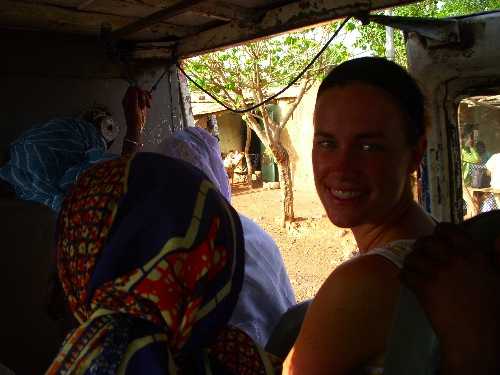 On the last day of my visit, a Sunday, Dianna invited my colleague from the University of Kankan, Sory Kourouma, who had accompanied me on the trip, and I to visit a church that she frequented in the nearby village of Tinkélé. Two of Dianna’s friends joined us: Momuso, a grandmother and the senior woman in the compound where Dianna was living, and Hamidou, Dianna’s Bamanankan teacher who exudes a contagious sense of peace.
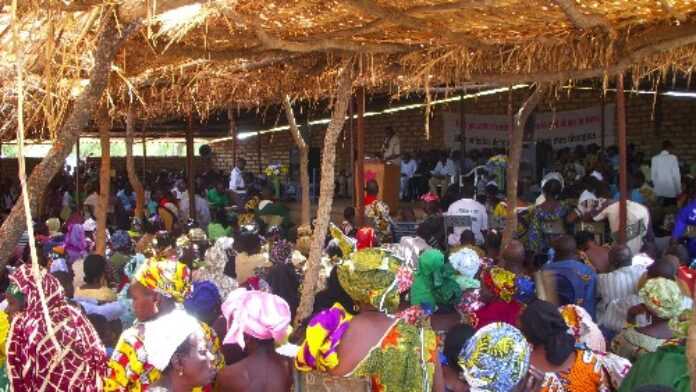
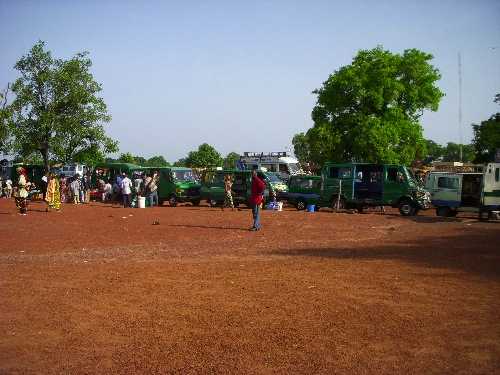
Together we took a twenty-minute minibus ride to Tinkélé, arriving at about 8:45 a.m. We disembarked onto the shoulder of a two-lane highway and found ourselves looking at a mud-brick wall. Within the compound behind the wall stood a tall corrugated metal roof suspended over a podium and stage. The podium looked out over an expanse of wooden benches sheltered from the sun by grass mats suspended over wooden supports.
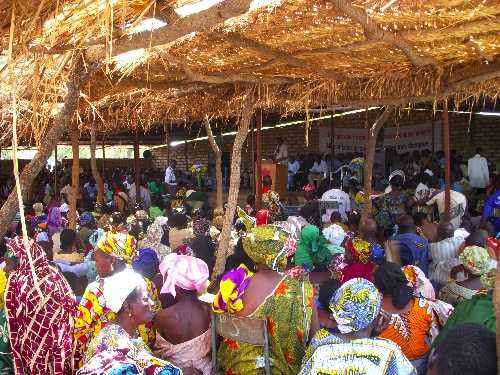 By noon, over a thousand people had gathered in the enclosure, mostly Muslims. Dianna, Momuso, Hamidou, Sory, and I sat under the metal overhang behind the podium in plastic chairs where church attendants had seated us.
The choir sat just below the stage to our right. They sang and danced for about an hour and a half before the pastor, Michel Samaké, arrived. Pastor Michel is a charismatic and controversial figure who has been expelled from his church hierarchy in Bamako for his unorthodox methods: preaching mostly to Muslims and performing healings and exorcisms. His expulsion seems not to have diminished his following.
 After he preached tirelessly for two hours about sin and virtue, salvation and scripture, the healings began. Several people rose from their benches, claiming to walk for the first time in days, months, or years. Pains in people’s bodies reportedly disappeared. Others came forward to testify about healings that had occurred since their last visit to the church.
Then came the exorcisms. Pastor Michel performed at least ten. They unfolded with great drama. Most began with women—or in one case a young man—quivering, sighing, collapsing, then screaming and sobbing on the ground. Men and women lifted them up and brought them before the podium where Pastor Michel prayed over them until they recovered, freed from the power of spirits called jina, from the Arabic, djinn.
At noon, as the temperature rose, Dianna was not feeling well and decided to leave the church to get some air, having seen services like this several times before. I was starting to fade myself and wondered if I might be joining her soon. But when the exorcisms began, I left my seat onstage to take pictures from among the crowd as I had already done since the service began. Attendants had given me permission to take pictures.
While I was shooting, I noticed commotion in the area where I had been seated. I then saw several men carrying Dianna’s friend, Momuso, down to the ground in front of the podium. She was screaming, tears trickling from her eyes. She writhed and wailed on the ground for almost a full minute, which at the moment seemed like an eternity. Now that Momuso was the only woman possessed, time seemed to stop, focused on her alone.
Pastor Michel changed his routine. No longer needing to pray on stage over several possessions simultaneously, he came down from it, approached Momuso and prayed over her personally, touching her left shoulder.
Throughout Momuso’s passion and Pastor Michel’s intervention, I took photos, overcome by a sense of urgency to do so in spite of a feeling of discomfort at doing so.
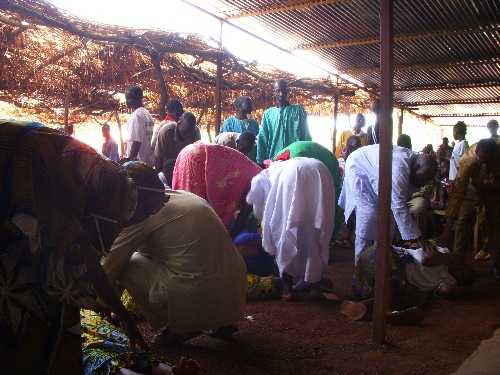 Possession is a moment of public intimacy, in which persons channel emotions before others they would normally repress: feelings of abandonment, anger, excitement, helplessness, shame, terror. No ethical protocol could have prepared me for these circumstances. How does one ask informed consent to take photos of a person in trance? How did I know that my pictures would not offend Momuso? Despite the permission I had received from the church, I felt I was intruding into lives and feelings I could never fully understand. I decided to shoot and wait until later to learn whether or not I had made the right decision. I was ready to delete the photos if I learned I had not.
Then, as suddenly as Momuso’s trance had begun, Pastor Michel finished a forceful prayer over her. Momuso went limp and then stirred as if awaking from a restful night’s sleep. She lifted her upper body off the ground by her arms, stood, and went to find her seat again on the stage.
I followed to retake my seat directly in front of hers. I turned in my chair to give her a bottle of water I had brought from Ouélessébougou and a meat-pocket I had bought at the commercial stands along the road before the service began. Attendants had told us not to drink or eat inside church during the service, but Momuso’s condition merited some rule breaking. She looked stunned, disoriented, astonished. Drops of sweat collected on her forehead. I tried to cool her with a woven rattan fan I had bought that morning. My friend Sory to my right also turned, took her right hand, and comforted her. I held her left. Hamidou, seated farther away, watched with concern. Dianna could do all this so much better, I thought to myself. She knows Momuso.
 After a few minutes, I left Momuso in Sory’s care and went to find Dianna to tell her what had happened. I found her outside talking with a taxi driver about his work bringing people to the church—informally interviewing at every opportunity, I thought, like a good anthropologist should.
We walked back to the church together and took our seats next to Momuso. Then Pastor Michel began to pray for a range of ailments for which he asked anyone afflicted to stand. Next he asked us all to stand and pray spontaneously for our unspoken intentions. The crowd rose, closed their eyes, raised their hands and unleashed their prayers in a glorious mumble that sounded like the humming of a hundred trucks on a highway. Again, the moment found me taking pictures. But not for long. This time I stopped. I closed my eyes, opened my mouth, and let the Spirit do the talking.
With that, the service drew to a close. After a final invocation, Pastor Michel exited the church his retinue behind him. The crowd slowly dispersed.
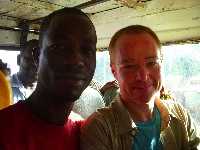 Back in Ouélessébougou, Sory and I packed and prepared to leave so we would arrive back in Bamako before sunset. I had little time to discuss what had just happened with Momuso or Dianna, but I left electronic copies of all the photos I’d taken with them.
Several days later, back in Kankan, Guinea, I called Dianna. She said she had begun to talk with Momuso about what happened in Tinkélé. Momuso claimed to have no memory of her possession. But she said that since she was a child, she had been plagued by dreams of drowning in a river that runs through Ouélessébougou. Coincidentally, jina spirits are often said to frequent rivers. The dreams had stopped since the exorcism, she said, but she was unsure they would cease for good.
Dianna told me that if it hadn’t been for the photos I had taken of Momuso, Momuso would never have believed she had been possessed, although she still thought the whole thing might be a trick.
We had all been taken by surprise. Momuso had no idea what had transpired. Dianna saw her in a new and unexpected light. My friend Sory, a Muslim who had never attended a Christian service before, said the experience moved him. He said that if Momuso had not been possessed, he would have taken the exorcisms for a show. As for Hamidou, he retained his characteristic silence, no doubt to write about the event one day (You can read his writings at www.hamidouko.blogspot.com). I marveled at how quickly one can gain such intimate knowledge of others’ lives.
Thrown together by circumstance, the five of us managed to explain to and for each other the sense of what had happened, perceived only partially by each of us in isolation. We created tenuously shared meanings across languages, cultures, and religions, demonstrating that no worldview was sufficient in itself to grasp the nature of what we had witnessed. So it is at the church in Tinkélé whenever Muslims and Christians come together to approach the divine across differences of faith and creed.
Momuso’s possession and exorcism, her recovery at the church, Dianna’s discussions with her in Ouélessébougou, and the photos I took seem now like memories from another world, one in which cultures cohere rather than clash, not in spite of, but because of their differences. Without difference, there is no wholeness. Without wholeness, no peace of mind. No chance to understand the dreams that may burst one day into our waking lives when we least expect them. No chance to know the joy of depending on others to carry us while in trance, take us back to our seats, and share the good news that genies have failed to drag us under.
